How Fidesz dug itself into a hole with its flagship policy
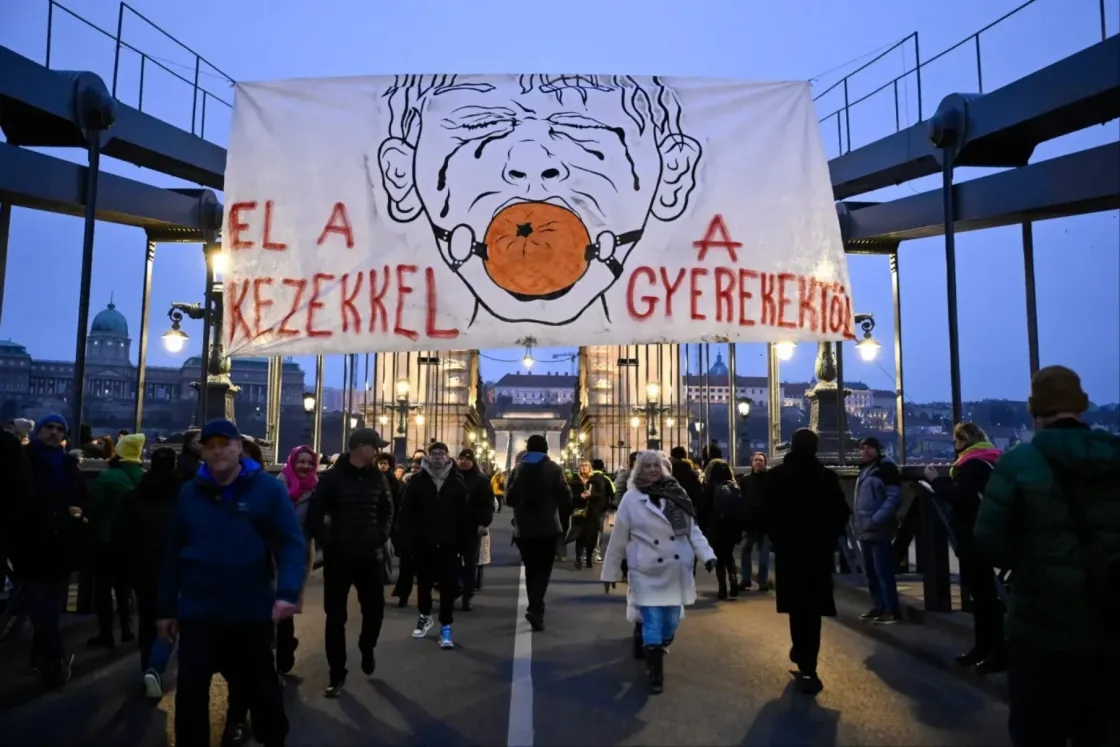

It wasn't overnight, and not even in the space of a year that the political failure came about, which is reflected in the Hungarian ruling party's struggle to handle the situation at the Szőlő Street reformatory and, more broadly, in the area of child protection and all that the recently closed institution in Budapest's Szőlő Street has come to symbolize. This is just one stage in a process that has been going on for at least six years. It is a series of political decisions and political communication, in which at the beginning, Fidesz saw an opportunity, and considered child protection a political tool, but today they would like to get rid of it, if only they could.
The story—at least from Fidesz's point of view – began in 2019.
It was then that Gábor Kaleta, Hungary's ambassador to Peru, was secretly recalled after a foreign authority found paedophile materials on the diplomat's computer during an investigation. 19,000 of them. The Foreign Ministry tried to cover up the affair, but it leaked out that Kaleta had been brought home, and we disclosed the story six years ago in Index, which at the time was not yet under government influence.
Kaleta's paedophile scandal hit Fidesz hard, even though the former ambassador was not considered a typical Fidesz official. As a career diplomat, he remained in office under several governments and consistently passed national security screenings, even before 2010. The fact that his double life was not exposed and he was able to remain in the system was as much the fault of the government at the time as that of previous governments – at least in a political sense.
Kaleta was convicted by the court in 2020. He received a suspended prison sentence, which outraged many. However, the court did not treat him differently from others; according to the laws and practices at the time, a defendant with no previous convictions was not required to serve time in prison. The public was outraged by Kaleta's sentence, considering it excessively lenient. This was probably due to the fact that the person at the centre of the case was not an ordinary person, but a diplomat, a high-ranking figure—otherwise, similar sentences handed down in the past would have also been met with discontent and serious media attention.
Sensing society's reaction to the verdict, not only was the opposition outraged, but so were government politicians. More importantly, they saw it as a political opportunity.
At that time, we were a year or two away from the 2022 elections. The ruling party could have ignored the issue and moved on, but Fidesz did the opposite: it amplified the public outrage against the verdict and, in a sense, took the lead in social discontent.
This is nothing new for Fidesz; it is not the first time that the ruling party has spoken out against a court ruling and amplified the voice of the people. In 2013, during the third year of Orbán's second term in office, Antal Rogán spoke out against the court's decision to place Eva Rezešová, a Slovak millionaire who caused a fatal accident while drunk, under house arrest.
Fidesz had two motivations. It was partly upset about the verdict in the Kaleta case because it wanted to distance itself from Kaleta, whom the public saw as being connected to Fidesz, and partly because it wanted to capitalise politically on the public outrage sparked by the verdict.
The backlash to the Kaleta case became a springboard for communication when the ruing party launched an anti-paedophile campaign based on these events. As part of this, Fidesz parliamentary group leader Máté Kocsis submitted an "anti-paedophile bill" to the Parliament. He did so after government propaganda had almost completely ignored the proceedings against Kaleta: while the proceedings were ongoing, there was hardly any mention of the case in the pro-government media; Origo, for example, did not cover it at all.
Just as in 2019 the opposition sought to blame Fidesz for the Kaleta affair, from 2021 onwards the ruling party linked pedophilia with the opposition, i.e. the "liberals," with at least as much vehemence, while positioning itself as the protector of children. The Centre for Fundamental Rights, for example, dug up a 2014 article of the daily, Népszabadság, titled "Pedophiles are people too," which they used as evidence that, in their view, the liberal side is "working to step by step instil understanding and tolerance" in regard to social abnormalities. During this period, blurring the lines between the LGBTQ community and pedophilia became a conscious strategy.
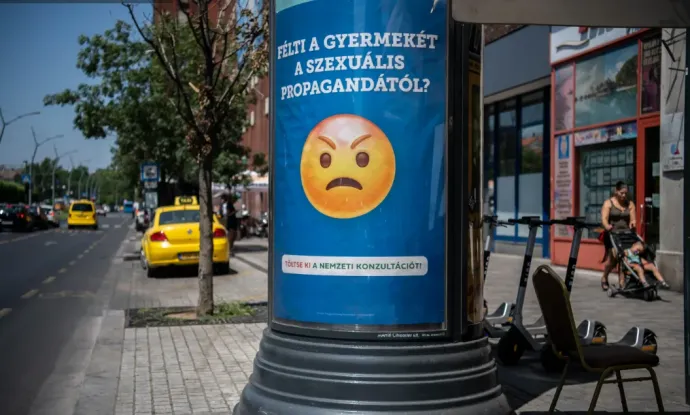
The incitement was not only directed against the opposition, but also strengthened Fidesz's identity. "We are the ones who protect children, while the other camp wants to corrupt them" – was the essence of their message.
From then on, the ruling party exaggerated and politicised every issue that could be even remotely linked to pedophilia for its own voter base. But they made a mistake. They raised child protection as their banner without any real backing, and the sector was in the same state as it is in now, when the closed Szőlő Street institution became a symbol of the failure of child protection. However, luck was still on Fidesz's side at that time. The child protection professionals who spoke out in public last year, either by name or anonymously, were still silent at that time.
In February 2024, the clemency case made it clear for the first time that, instead of building a communications bastion, Fidesz had dug a pit for itself after 2021. It then emerged that President Katalin Novák had granted clemency to a man convicted as an abettor in a paedophile case, a decision that was likely influenced by high-ranking individuals intervening on his behalf. The reason why the clemency case caused such a stir was that Fidesz had already sensitised its own voter base to this issue with its own reaction to the Kaleta verdict. The clemency case completely ran counter to the child protection role that Fidesz had been systematically building up since 2021. What's more, the Kaleta case returned, but not in the way Fidesz had been building it up since 2021, but in its 2019 version. When people thought of the Kaleta case, they thought of Gábor Kaleta, a Fidesz-linked politician, not of Fidesz speaking out against the verdict in the Kaleta case.
The political developments surrounding the scandal at the Szőlő Street reformatory follow a similar pattern.
After the clemency scandal, Fidesz was not satisfied with the political sacrifice of the resignation of Katalin Novák, President of the Republic, and Judit Varga, former Minister of Justice. They did not allow the real background of the clemency case to be revealed, even though they could have done so, but they had to offer something, mainly in order to preserve their identity as the protectors of children. They needed something that would erase the traces of the clemency case, something that could be shown on television. Something that would prove in black and white that the government is indeed on the side of good, and stands against the evil child abusers.
This is when the National Protection Service (NVSZ), which is part of the Ministry of the Interior, came into the picture. This is the organisation that had previously taken action against corrupt police officers and doctors who accepted bribes. Why couldn't it expose criminals in the social and child protection sectors? The message from politicians was unambiguous: investigate and expose the crooks! If possible, make a video of their arrest!

As a first step, the NVSZ was tasked with conducting investigations into the impeccable lifestyle of the individuals concerned. When news of these investigations spread, legal advocates and those employed in the sector complained that they seriously violated the privacy of those involved, as the investigations not only extended to those employed in the sector but also to their family members living with them. At that time, critical voices in public discourse claimed that these investigations were unnecessary, superfluous, and amounted to harassment. However, it was precisely this procedure that led the authorities to recognize that there were serious problems with Péter Pál Juhász, the director of the Szőlő Street reformatory. The NVSZ then conducted a secret investigation against him in the fall of 2024, and took him into custody in the spring of 2025.
This could have been a success story for law enforcement, and politically, the ruling party could have justified the need for stricter controls. However, the story took a different turn – partly due to the undisclosed details of the clemency case, the emboldened opposition, but mostly due to the ruling party's communication reflexes.
Juhász had already been arrested when it emerged that reports about his activities had been sent to the police by some of those employed in the child protection system years before, but without real consequences. This happened when Fidesz was already in power, so they should have been looking for those responsible in the ministries led by Fidesz officials. This was compounded by the fact that Juhász had been able to operate in a favourable political environment for a long time and had cultivated good relations with the pro-government world. As a result, many concluded that his political connections made him untouchable. This was brought to light partly by investigative reporting in the independent press and partly by public statements from child protection experts, who were now speaking out more courageously.
It is impossible to know which of these accusations are true and which are mere speculation – and it is precisely this uncertainty that has fueled the scandal around the Szőlő Street case. Fidesz's reaction was not an attempt to uncover the past, but an instinctive counterattack. They mostly insinuated that those speaking out from the social sphere were not credible. But since there was a complete lack of effort on the part of the government to uncover the past, the voices that fill in the missing pieces of the puzzle with their own fantasies only grew louder. And when this is combined with anti-elite and anti-political sentiment, it creates a vicious cycle, such as the "Uncle Zsolti" scandal. Contrary to the ruling party's communication, "Uncle Zsolti" is not the result of the machinations of a foreign secret service, but was driven and initiated by a lack of information and an unexplored past, with anti-government sentiment merely reinforcing it.
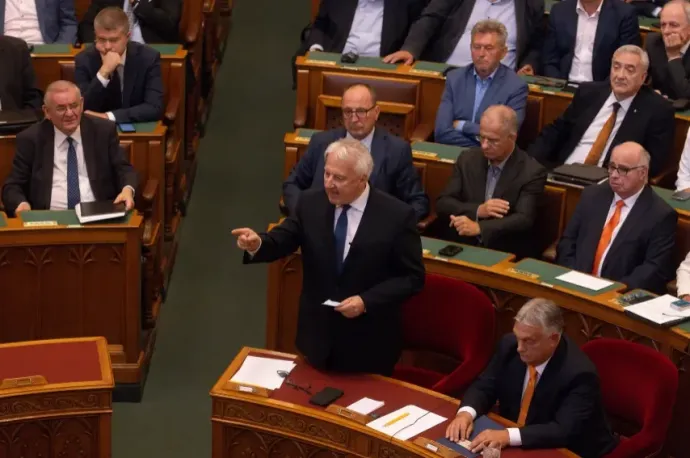
It is a strange twist of fate that these rumours were reinforced in parliament by the Democratic Coalition (DK), a party which is fighting for political survival. And then came another political mistake by Fidesz, or rather its satellite party KDNP: party leader Zsolt Semjén fell for the DK's provocation in parliament and took the whole story upon himself.
At that point, Fidesz must have felt that they were being forced into a corner. They couldn't leave Semjén alone, and with the KDNP leader defending himself and offering explanations, the ruling party also got dragged into the affair. Fidesz then stood firmly behind Semjén, but made another political mistake: it mobilised the state apparatus in a sort of hybrid regime style. At 11:59 a.m. on September 24, Minister of Justice Bence Tuzson spoke in a Facebook video about a government report on the case he was about to submit (with the finished document in hand), but the decree authorising its preparation was only published in the Hungarian Gazette at 1 p.m., which was when it came into force. An even bigger mistake, however, was that Tuzson stated, based on the report, that there were no underage victims, no politicians' names had come up, the ministers were innocent, and he even hinted at the involvement of a foreign secret service.
The only problem was that the report made too many categorical statements, and did so too early. At that point, the police had made almost no progress in their investigation. Furthermore, although it was formally true that no minors were involved in the criminal case against Juhász at that time, Juhász had been dismissed in March 2024 precisely because of the allegations made by a former minor from an institution he had worked at. Although he was not named as a suspect in that case, proceedings were initiated against an unknown perpetrator for endangering minors. Since then, it has also come to light that several other minors were also involved.
If the hastily compiled Tuzson report had refuted only Semjén's involvement, Fidesz would not be in such an awkward position today. Especially because, even though a government summary was quickly put together in response to the rumour campaign, there is still no reassuring answer as to who failed to take action in the case of Juhász for years, and why – neither in the police nor in the state administration. This adds to the uncertainty that keeps the Szőlő utca scandal alive. It is another matter that the ruling party was late. At this point, the ruling party can only get out of this well if legal proceedings on the case take place after the elections, because every new scandal, every new skeleton that falls out of the closet points to the flaws and shortcomings of the child protection system.
Even though child protection itself probably did not become what it is today under the Fidesz government. This is well illustrated by the fact that, according to recently disclosed ombudsman reports, the situation was not rosy even before 2010. But it was Fidesz that turned it into a political issue, only to fall into the pit it had dug for others.
In 2007, under the Gyurcsány government, a boy named Barnabás was raped and murdered by his fellow inmates in the Tököl juvenile prison. Barnabás was behind bars for theft, and the staff did not protect him. We could say that the system did not protect him, yet his murder was not followed by protests or anything else. It did not become a political issue. But who knows what would have happened if the Gyurcsány government had made child protection its priority? Fidesz would probably not have missed the opportunity to turn the Tököl case into a political issue.
Fidesz began to build its child protection agenda in 2021, in its own particular, homophobic way. Several years have passed since then, and as we have seen, it took several steps for child protection ultimately becoming a weakness rather than a strength for the ruling party. If Fidesz had not built a full-blown anti-paedophile campaign in the wake of the Kaleta affair, the clemency scandal would not have caused such a rift within its own camp.
If, after the clemency scandal, the NVSZ had not been entrusted with "cleaning up" child protection, the Szőlő utca affair would not have exploded in this way.
If the full background of the clemency case had been revealed to the public, perhaps not everyone would suspect conspiracy and high-level political connections behind individual crimes.
And if Semjén had not taken the attack on himself, and the ruling party had not defended him with a hasty ministerial report, the current investigation by the Central Investigative Prosecutor's Office – which has already revealed that several minors had been affected – could even be presented to voters as a success story.
With the closure of the Szőlő Street reformatory, Fidesz clearly wants to drop the issue, saying that if there is no Szőlő Street reformatory, then there is no Szőlő Street issue to talk about. However, Szőlő Street is no longer a geographical location, but a symbol of abuses and cover-ups in child protection. And even if Szőlő Street is closed, the publick will continue to see the lack of information as problematic. This lack of information is keeping the scandal alive and will provide endless ammunition to those who took Fidesz's weapon away from the ruling party and turned it against the Orbán regime. The weapon loaded in 2021, which Fidesz originally intended to use to hunt down its opponents, backfired in 2025 – and not just once.
What is this called again? A hunting accident.
For more quick, accurate and impartial news from and about Hungary, subscribe to the Telex English newsletter!