Four years ago, Hungarian air defense watched idly as a Ukrainian drone flew over the country; now the government is using the incident to incite fear


“To those who feel that the enhanced protection of our energy infrastructure is excessive: when Hungary made it clear after the outbreak of the war that it wanted to stay out of it, a Ukrainian drone flew over the Paks nuclear power plant.”
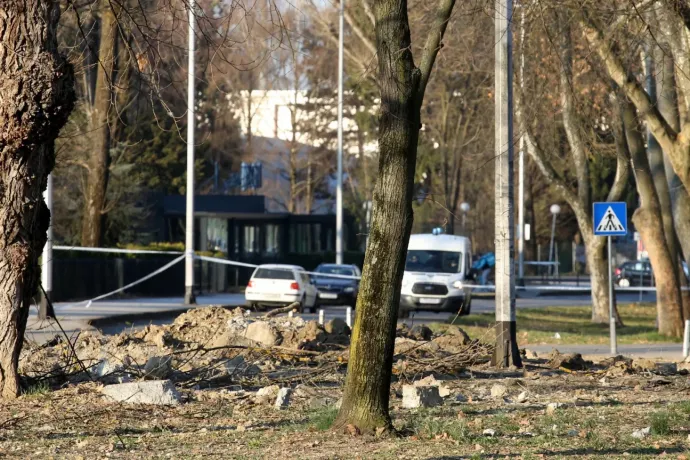
The above statement was made by Gergely Gulyás, Minister of the Prime Minister's Office at Thursday's government briefing. The government considered this message so important that they later dedicated a separate post to it on the official Facebook page of the Hungarian Government. Gulyás was referring to an incident that occurred during the first weeks of the Russian-Ukrainian war, when an ancient Soviet-made drone flew through Hungarian airspace, specifically over Paks, and then crossed into Croatian airspace, crashing near Zagreb, creating a large crater. It was only thanks to luck that no one was injured in the crash. The drone spent 40 minutes in Hungarian airspace without being shot down by air defense.
According to news reports at the time, the drone entered Hungarian airspace after a brief flight over Romania. The Romanians claimed that it only spent three minutes in their airspace and said there were several circumstances which prevented them from shooting it down. The Hungarian Ministry of Defense reacted with the following statement: "On March 10, 2022, during the night, the Hungarian Armed Forces' airspace protection service detected a flying object that was occasionally visible on the radar screen in Hungarian airspace." They added that they had detected the device – which they described as outdated – while it was still flying over Ukrainian territory, and said they had tracked and monitored it the entire time. In addition, they wrote that the radars later detected another unidentified flying object over eastern Hungary, but the Gripen fighters sent to intercept it did not find any airborne vehicles.
Croatian Prime Minister Andrej Plenković said at the time that it was unacceptable that NATO and Hungary not only failed to shoot down the drone, but also failed to inform the Croatians in a timely manner. Another unusual reaction of the Hungarian government relating to this took place on the evening of March 17, when Lajos Kósa, then chairman of the Defense Committee, canceled the committee's meeting scheduled for the next day without explanation.
The device reportedly flew over Hungary at a speed of 700 km/h and an altitude of 1,300 meters. The large drone travelled at least 560 kilometers without any apparent reaction from NATO air defenses in Croatia, Hungary, and Romania. Both Ukraine and Russia denied that the drone belonged to them. It was revealed two days later that the drone was also carrying explosives, meaning that it was not (only) intended for reconnaissance purposes. The bomb it was carrying was later identified, and it was determined that the aircraft's black box, which contained flight data, had been destroyed.
The capability is there
Immediately following Thursday's government briefing, analysts and commentators highlighted the contradictions between the government's current communication and its handling of the drone incident four years ago. Russia expert András Rácz analyzed the government's statement on his Facebook page. He recalled that the device was a Tupolev Tu-141 reconnaissance drone, which was put into service in the Soviet Union in the late 1970s. It is a 15-meter-long device with a wingspan of almost 4 meters, weighing more than 6 tons. As Rácz put it, “It's the size of a small bus, only it flies.”
The Tu-141s were not really in use anymore, but in the wake of the Russian invasion in February 2022, Ukraine brought them out of storage and made them airworthy. These drones could not be remotely controlled, they flew on pre-programmed routes, and they were sometimes equipped with explosives. It is likely that one of them malfunctioned and, after making a 180-degree turn, headed in the opposite direction, towards Hungarian airspace. According to Rácz, the information on why the device, which even flew over Paks, the location of Hungary's only nuclear power plant, was not taken down had been declared classified for 30 years. Rácz claims that the large drone flying on a fixed course would have been an easy target for the air defense. He sums it all up as follows:
“It wasn't the fault of the Defence Forces, but of the political decision-makers who probably didn't dare make a decision, hoping instead that it would fly on without incident and then crash somewhere in Croatia.”
In any case, during Thursday's government briefing, Gulyás said that the Defence Forces have the capability to shoot down a drone if it is flying within detectable range. Last October, Prime Minister Viktor Orbán made a similar statement: "If something flies into Hungary and does not belong to us, we will shoot it down – whether there is a drone wall or not." If there are drones "that do not belong to the state, shoot them down," he reiterated when unidentified, presumably Russian drones were regularly appearing around European airports and critical infrastructure.
This is precisely why it is strange that in 2022, the air defense did not shoot down the unknown drone, and now the government is using the possibility of such incursions to justify the deployment of soldiers and the introduction of a drone ban.
The above measures were announced by the Prime Minister on February 25 with the following justification: “I see that Ukraine is preparing for further operations to disrupt the Hungarian energy system. I have therefore ordered the reinforcement of the protection of our critical energy infrastructure.”
In addition to soldiers, "equipment necessary for repelling attacks" will also be stationed at these locations. The Prime Minister did not specify what kind of attacks he was referring to. The police are also being mobilised and will increase their patrols around designated power plants, distribution stations and control centres. In addition, a ban on drone flights will also come into force in Szabolcs-Szatmár-Bereg County, which borders Ukraine.
Viktor Orbán's statements alluded to the fact that, following a Russian bombing attack, deliveries through the Druzhba oil pipeline, which also passes through Ukraine, have been halted, and the Hungarian government believes that the Ukrainians are delaying the repairs and the re-opening of the pipeline. Orbán also referred to this in his radio interview on Friday morning, where he went as far as to say that Ukraine had attacked Hungary.
For more quick, accurate and impartial news from and about Hungary, subscribe to the Telex English newsletter!