Magyar threatens to oust President Sulyok by amending constitution
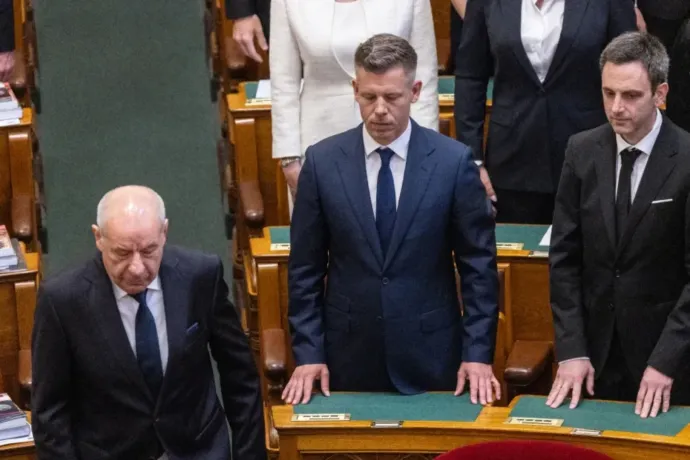

On Monday morning at Sándor Palace – the official residence of the President of Hungary, Péter Magyar personally called on Tamás Sulyok to resign. Since the President already indicated in his video on Sunday that he would not step down voluntarily, the Prime Minister announced that they would begin amending the Fundamental Law immediately. The Prime Minister said that the Tisza Party’s parliamentary group would discuss the proposal behind closed doors as early as Monday, and would later submit it to Parliament.
Telex learned from several participants in the parliamentary group meeting held ahead of the parliamentary session that Péter Magyar briefed the MPs on his meeting with the President, but did not share with them details about how the Fundamental Law would be amended. The faction had to vote on whether they support continuing down this path, that is, finding a solution to the promise that they would elect a new president to replace Tamás Sulyok. The faction unanimously supported this course of action. One participant said that they are only just beginning to draft the proposal and expects that several options will be worked out, from which the faction will then choose “the humane one.”
“According to the Fundamental Law, there are several options for removing the president from office,”
– Magyar stated after leaving the Sándor Palace yesterday morning. One option would be impeachment proceedings, but he promised that, in order to protect the remaining prestige of the office of the president, they would not be going down that route.
Under the current rules, the Constitutional Court’s cooperation would be required in any case during impeachment proceedings. The President of the Republic may only be removed from office if he or she fails to comply with the Fundamental Law, intentionally violates a law in connection with exercising his or her office, or intentionally commits a criminal offence. If a two-thirds majority of Parliament initiates impeachment proceedings, the President of the Republic may no longer exercise his or her powers; however, the final decision falls within the jurisdiction of the Constitutional Court. They may remove the President of the Republic from office if they determine that he or she has violated the provisions of the Fundamental Law.
The Tisza Party majority could eliminate the Constitutional Court’s role in the impeachment process, but according to Magyar, they will opt for a different solution. However, he revealed virtually nothing about the details of this on Monday morning. “We will amend the Fundamental Law as necessary. We will not resort to tailor-made legislation, as some have tried to suggest and frame it in advance, but we will restore the Hungarian rule of law and Hungarian democracy based on the clear, strong mandate of millions of Hungarians.” According to the Prime Minister, they will simply translate the mandate received from voters on April 12 into legislation. “The rule of law in Hungary and Hungarian democracy must be restored through a public act. The Hungarian people approved this with an unprecedented mandate on April 12.”
Tamás Sulyok drew a completely different conclusion from his meeting with the PM. In his view, the government is evaluating and interpreting the constitutional role of the office of the President of the Republic based on unilateral political expectations that deviate from the Fundamental Law. However, in his view, this does not provide a constitutional justification for his resignation, and If he is to remain faithful to his oath to uphold and ensure compliance with the Fundamental Law, he cannot comply with the demand. “Based on the Prime Minister’s statement made in the presence of the Minister of Justice, the Government plans to amend the Fundamental Law through tailor-made legislation with the aim of removing me from my legally held office. Constitutional law refers to this process as political plunder. According to the President, this would lead to a constitutional crisis which would deepen social division and damage the international reputation of Hungarian democracy, which in turn may ultimately affect the disbursement of EU funds tied to the rule of law.
According to Fidesz's parliamentary group, it is only in a dictatorship that a president is removed from office through the use of force, blackmail, or threats.
“Péter Magyar’s unlawful ultimatum is null and void from the point of view of constitutional law. He is pathetic and ridiculous.”
– they wrote in their reaction to the Prime Minister’s press conference.
Magyar said that it would take roughly a month to amend the Fundamental Law, which, under the current house rules, cannot be rushed through Parliament in a few days via an expedited procedure, but must go through the normal legislative process. According to the Prime Minister, however, the process must begin immediately because this is an urgent situation, as “the former ruling party, Fidesz, which is on the verge of collapse, is attempting to use the President of the Republic to trigger a constitutional crisis.”
Under the current Fundamental Law, the term of office of the President of the Republic ends if
- their term of office expires (Sulyok’s term runs until March 4, 2029);
- they die;
- they are unable to perform their duties for a period exceeding ninety days;
- the conditions necessary for their election no longer exist;
- a conflict of interest is declared;
- they resign; or
- they are stripped of their office.
None of these conditions currently apply. In his video released on Sunday, Sulyok stated that there is no constitutional basis on which he would consider his resignation justified; therefore, he will continue to perform his duties and exercise his powers as President of the Republic in accordance with his oath of office. The conditions required for his election remain valid, as, according to the Fundamental Law, any Hungarian citizen over the age of 35 is eligible to be elected President of the Republic. In Sulyok’s case, there is also no conflict of interest. It is conceivable that a two-thirds parliamentary majority could simply amend or supplement this section with an additional requirement that Sulyok would no longer be able to meet.
However, Magyar also told reporters that all public officials who have been called upon to resign will be removed by means of a public law act. They include Chief Prosecutor Gábor Bálint Nagy; Péter Polt, President of the Constitutional Court, and the other 14 members of the Court; András Zs. Varga, President of the Supreme Court; György Barna Senyei, President of the National Judicial Office; László Windisch, President of the State Audit Office; Csaba Balázs Rigó, President of the Hungarian Competition Authority; and András Koltay, President of the National Media and Infocommunications Authority. Based on this, it is therefore expected that they will not only rewrite the section that regulates the terms of the President of the Republic’s mandate, but are also preparing a more general, broader amendment, which is important because by doing so they would avoid creating tailor-made legislative measures.
Pursuant to Article 1 of the Fundamental Law, the Parliament elects the President of the Republic, the members and the President of the Constitutional Court, the President of the Supreme Court, the President of the National Judicial Office, the Prosecutor General, the Commissioner for Fundamental Rights and their deputies, and the President of the State Audit Office. It is conceivable that this section will be supplemented with a provision allowing a two-thirds majority to recall officials elected by Parliament. The question, of course, is what justification they will find that can be interpreted within the framework of the rule of law. Moreover, such an amendment would also need to be incorporated into several other laws governing the election of public officials.
There are no technical obstacles; a two-thirds majority can essentially do anything, since there is no content control over amendments to the Fundamental Law. Under an amendment adopted in 2013, the Constitutional Court may only review whether procedural requirements were violated during the amendment process. If no such violation is found, the President of the Republic is required to sign the adopted bill; they have no discretion in the matter.
If Sulyok’s term were to be terminated, the Speaker of the National Assembly, Ágnes Forsthoffer, would temporarily exercise the powers of the President of the Republic. Under current rules, the President of the Republic is elected by a two-thirds majority of Parliament. Magyar told Telex that they have not yet identified a candidate for the position, but it is certain that they will not nominate a party politician; rather, they are looking for someone who can restore the prestige of the office of President of the Republic.
Since Hungary's regime change, no president of the republic has ever been removed from office. Tamás Sulyok’s mandate lasts until March 4, 2029. According to Prime Minister Péter Magyar, Sulyok must be removed because he does not represent the unity of the nation, as he has served the Orbán government as a mere puppet in every respect and has failed, for example, to publicly stand up for the underage victims who were abused in the state child protection system. The Prime Minister has said that on April 12, the Hungarian people voted for a change of regime, and that includes removing all of Orbán’s puppets.
For more quick, accurate and impartial news from and about Hungary, subscribe to the Telex English newsletter!