Orbán ordered raid on Ukrainian cash transport, even timing decided at highest level



It was the government—in fact, Viktor Orbán himself—who decided that the Ukrainian “gold convoy” (as the pro-Fidesz media later referred to it) should be intercepted on March 5, even though there was no professional justification for the interception, sources familiar with the matter or directly involved in it revealed to Telex in a series of conversations over the past few weeks.
On March 5, two armored vehicles transporting cash from Austria to Ukraine were intercepted and pulled over by a police car at the Alacska rest stop near Budapest. The shipment was traveling from Raiffeisen Bank in Austria to the Ukrainian headquarters of Oschadbank via a regularly used transit route. Fully armed members of the special forces of the Hungarian Counter Terrorism Center (Terrorelhárítási Központ-TEK) were already waiting for the Ukrainians at the rest stop. The 27 billion forints worth in cash and investment gold found in the vehicles were seized by the Hungarian Tax and Customs Administration (Nemzeti Adó- és Vámhivatal-NAV), while the Ukrainian security personnel were released hours later and expelled from the country.
The incident, which came to light the following day, sparked a significant amount of reactions internationally. Meanwhile, the Orbán government boasted about the spectacular operation and shared the video footage recorded by the TEK on its official Facebook page. In its communication, the government implied that the Ukrainians had been transporting the money and gold illegally. Ukraine saw it entirely differently; according to Kyiv, Hungary had simply stolen the Ukrainians’ money. A statement by János Lázár at the time seemed to confirm the latter, as the then-Minister of Construction and Transport said, “We don’t know who sent this cash or why, but we’re not giving it back.” Lázár made these remarks after Viktor Orbán issued a decree stating that Ukraine would definitely not get its gold and money back for two months, and that the assets would remain under the supervision of the Hungarian authorities until the investigation concluded.
At the same time, the National Tax and Customs Administration launched proceedings citing the suspicion of money laundering, while the Austrian central bank stood perplexed by the accusations, claiming that the transfer of cash between countries is a standard and legal banking practice. The Austrian authorities also found nothing objectionable or irregular about the transport or the money. In mid-March, the legal representative of the Ukrainian Oschadbank filed a complaint with the Central Investigative Prosecutor’s Office in Budapest on suspicion of abuse of office and an act of terrorism.
After Fidesz lost the election, things took a turn.
The National Tax and Customs Administration — by now, paying no heed to Orbán’s decree — returned the seized assets to the Ukrainians, while the National Directorate General for Aliens Policing revoked the expulsion order against the Ukrainian cash couriers, along with the travel bans against them. It also turned out that the prosecutor, who had access to the classified documents, concluded that in the immigration proceedings, the Constitution Protection Office (AH) had failed to provide sufficient evidence to support the claim that the Ukrainians posed a national security risk.
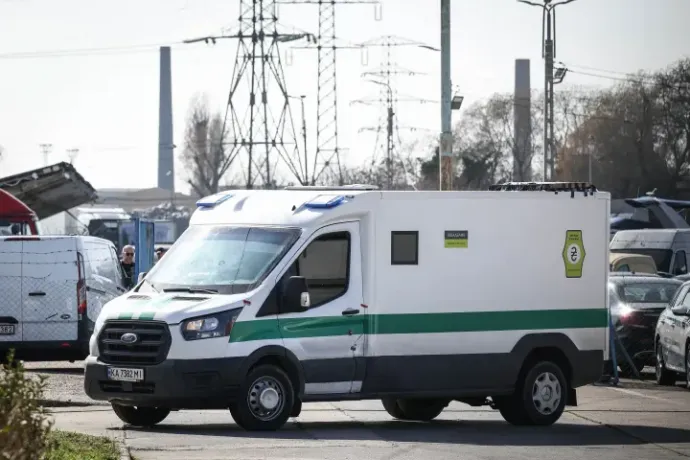
In recent weeks, we have been able to speak with numerous sources who were directly or indirectly involved in the case or had a clear understanding of the background processes leading up to the operation at the rest stop. Although these individuals—while downplaying their own responsibility—regularly pointed fingers at one another during the conversations, there was one point on which all their narratives aligned. Namely, that it was only on paper that the operation against the convoy transporting cash and gold was initiated by the authorities and that in reality, there were political calculations behind it; they merely assisted in carrying out the will of those above them.
We found out that the report was filed the day before the interception by the Constitution Protection Office, (Alkotmányvédelmi Hivatal -AH) which is responsible for counterintelligence—a fact the AH confirmed in response to an inquiry from Telex. They also confirmed our understanding that the report was not based on their own information, but on data collected by the Information Office (Információs Hivatal – IH).
The AH and the IH are two separate intelligence agencies. The AH is responsible for counterintelligence and internal security, meaning it operates domestically, while the IH is responsible for gathering intelligence, and is therefore primarily focused on activities abroad. Although they are separate organizations, during the previous government cycle, both agencies were under the supervision of Antal Rogán, the most powerful minister in the Orbán administration.
To understand the background of the “gold convoy,” it is important to note that, ever since the war in Ukraine started, and all the way until the events at the rest stop in Alacska on that March day, Ukraine has been moving massive amounts of cash through Hungarian territory—amounting to as much as several thousand billion forints annually. As detailed in a previous article, this logistical operation was for years coordinated and carried out by a company linked to István Garancsi, a member of Viktor Orbán’s inner circle. According to our information, the vast majority of the massive amounts of money bound for Ukraine originated in the United States.
Although our information indicates that the IH became aware of the shipments in 2025, during the background conversations conducted by Telex, we heard different explanations as to where the story began.
According to one account, the IH wasn’t even interested in the money transfer or the funds themselves, but was instead focused on a former Ukrainian intelligence officer, Gennady Ivanovych Kuznetsov. Intelligence agents were reportedly aware that Kuznetsov had been previously affiliated with the Ukrainian secret service, so when they learned that he had entered the country on multiple occasions, they began monitoring his activities. It was only then that they linked him to the otherwise entirely legitimate cash transports in which he was involved.
Those within Hungarian intelligence circles believed it to be no coincidence that the Ukrainians had entrusted this task specifically to Kuznetsov. To their knowledge, the former secret service agent maintained a particularly close relationship with Andriy Yermak, one of President Volodymyr Zelensky’s confidants and the former head of the Office of the President of Ukraine. Yermak is currently facing money laundering charges in Ukraine. Furthermore, Kuznetsov’s past is not entirely spotless either. According to official Ukrainian court records, he was convicted by a Kyiv court in 2011. To our knowledge, information gathered by the IH indicates that he was convicted in a corruption case, and several Ukrainian online news sources have reported the same, though the credibility of these is questionable. What is certain, however, is that Kuznetsov was indeed convicted by a court.
The latter detail is significant in that the authorities later tried to link the cash transport to money laundering, and the suspicion itself likely arose primarily because of Kuznetsov’s past. However, the suspicion stood on rather shaky ground, even if there were indeed other oddities besides the former secret agent’s connections and criminal record. For example, the fact that cash was not only being transported to Ukraine but also back to Austria, and in no small amounts. The Ukrainians partly explained this by saying that they were transporting damaged banknotes. The Hungarian authorities found it strange that there would be so many damaged banknotes, and it was precisely Kuznetsov's involvement that led them to suspect that there might be something else, perhaps a corruption scheme in the background. After all, European authorities are also trying to keep track of Ukrainian corruption cases, given that the fate of Western aid is at stake.
Although these shipments have been going on without a hitch since 2022, and the Ukrainians even signed an official contract with the Hungarian police last year to provide armed security for the convoys, they only requested a police escort three times last year and once this year. On these occasions, the Ukrainians paid market-based fees to the Hungarian police for their protection. It was unclear to the Hungarian authorities why, if the logistical operations were ongoing and involved such large sums of money, they would request official escorts on such rare occasions. They also found it suspicious that the Hungarian-language contract signed with the police differed in certain points from the text of the English- and Ukrainian-language contracts which the services had obtained. While the Hungarian version listed the Ukrainian state-owned Oschadbank as the final recipient of the shipment, the English and Ukrainian-language documents designated a Warsaw-based financial institution as the beneficiary. And they also couldn’t understand why such a large sum of money was being transported without any weapons.
However, the above are, at most, merely suspicious circumstances that would require clarification or further covert investigation, since they do not in themselves violate the law—nor are they irregular. For the government, however, this information obtained by the IH proved sufficient to make a case out of it – even though they only became aware of some of the above information long after the interception, meaning that prior to the operation, they were working with even less information.
The timing of the raid was no coincidence either. Viktor Orbán was convinced that the Ukrainians were refusing to allow oil to reach Hungary via the Friendship pipeline—which had been damaged in a Russian attack—for political reasons, and not because they were unable to repair the damaged pipeline. According to a source familiar with the internal affairs of the previous administration, this conviction was the reason why Orbán pushed for the raid. The PM wanted to send a strong response to Kyiv.
Not only did a source involved in the matter claim that this was what motivated Orbán, but a statement made by the former PM also suggests this. At the annual spring economic conference of the Hungarian Chamber of Commerce and Industry (MKIK) on March 5, Orbán announced that the Hungarian government would force the Ukrainian leadership and the EU to resume oil shipments via the Druzhba pipeline before the country's gas reserves run out.
“We will win, and we will win by using force; there will be no compromise—we will break the oil blockade. We will force the Ukrainians to resume oil shipments by using force. They must open the Druzhba pipeline unconditionally and immediately,”
Viktor Orbán said at the event. The timing is significant, as this was on March 5, although the public knew nothing about the events of that day yet.
Sources familiar with the details of the case revealed that the case "landed with" the National Tax and Customs Administration (NAV) thanks to the prosecutor’s office. In response to an inquiry from Telex, the spokesperson for the Office of the Prosecutor General, Dr. Géza Fazekas, stated: since the report of the AH was based on a mere suspicion of money laundering, the prosecutor’s office referred the case to the NAV's Criminal Directorate and designated the NAV as the investigating authority. “The NAV then ordered the investigation based on the complaint,” Fazekas wrote to our paper. In his response, the spokesperson noted that the convoy’s interception happened after this, which the prosecutor’s office was unaware of at the time and only learned about after the fact.
Although the NAV has its own tactical unit, they were not the ones assigned to carry out this operation, but rather the Counter Terrorism Center (TEK). One of the explanations our sources gave for this was that they believed the Ukrainians would be armed, and they judged that the TEK was better prepared for such a situation. However, a source close to the government did not deny that the decision was also politically motivated, as deploying TEK is inherently more high-profile than the Merkúr commando unit used by the NAV. In response to our question on this matter, TEK said that, under the law, it has exclusive jurisdiction in certain cases to “apprehend and bring in persons suspected of criminal offenses on behalf of the agencies making the request,” and that the NAV had requested their assistance in this task.
However, the Ukrainians brought in by the TEK were not suspected of any crime, but were nevertheless kept in handcuffs throughout. In fact, the Budapest Investigative Prosecutor’s Office has since initiated proceedings for unlawful detention and other criminal offenses.
Our contacts offered various explanations as to why it was not the IH that filed the report, given that the intelligence officers were the ones who had carried out the reconnaissance. Some of those involved said that it was the AH because they are the ones who typically handle procedures related to foreign nationals, and indeed, a procedure was later initiated against the cash couriers under immigration law. According to another explanation, it would not have been advisable for the intelligence agency—which also collects data abroad—to become involved in the operation.
Another explanation put forward was that the IH did not want to be the one to make the report because they knew full well that the allegations of money laundering were rather flimsy. In fact, some of our sources claimed that the IH was hit particularly hard by the report and the subsequent crackdown because the intelligence officers had plans involving Kuznetsov, and the whole affair completely derailed the efforts they had made up to that point.
It is difficult to determine which explanation is closer to the truth, because during our conversations, it seemed that those involved were shifting the blame onto one another and noticeably downplaying their own roles. Several sources said that instructions from the government about when the raid should take place arrived in early March. The Constitution Protection Office also confirmed this information in response to our inquiry. In its reply to Telex, the CPO stated:
In early March, the State Secretariat for the Supervision of Civil National Security Services, within the Prime Minister’s Office issued a directive stating that “the raid on the cash-in-transit vehicles must take place on March 5.”
According to our information, the State Secretariat acted upon instructions from Viktor Orbán, who was regularly informed of the developments on the day of the operation.
Several independent sources have confirmed to us that the operation against the “gold convoy” was ordered by Viktor Orbán, and that he was the one who insisted on it.
The prosecutor’s office, however, denied that they had received any information from the government about organizing the operation.In response to our inquiry, they stated that “during the investigative phase of the probe, the prosecutor’s office is responsible for ensuring legal compliance; in doing so, it makes decisions independently—rather than in cooperation with other branches of government—and it has not been in contact with either the previous or the current government.”
Although, according to Telex’s sources, Viktor Orbán decided to carry out the operation in response to the “shutdown” of the Druzhba oil pipeline, in its communication, the previous government sought to exploit this story to push another narrative it had been promoting—suggesting that the Ukrainians’ money came from dubious sources and was being used to finance opposition parties. The whole story was enveloped in this insinuation; moreover, Fidesz's media empire sold the “scandal” by spicing it up with AI-generated images, portraying the Ukrainian money couriers as captured criminals. As Lakmusz subsequently reported, unmarked AI-generated images and a flood of foreign likes helped spread the posts on Mediaworks’ publications about the Ukrainian cash couriers.
In the wake of the scandalous operation, however, the Ukrainian side also took action. Ukrainian sources told the Guardian that Hungarian authorities had administered a “truth serum” to the former Ukrainian general overseeing the transport. The Ukrainians provided no evidence to support this, but given the circumstances, it is not surprising that they, too, responded with disinformation. The man in question is a diabetic, which the Hungarians were unaware of; however, when he became ill, they had to act, as a result of which he received medical care.
Moreover, Fidesz was not the only one trying to exploit the case for an anti-Ukrainian campaign; the Austrian far-right Freedom Party (FPÖ), an ally of Viktor Orbán, did the same. FPÖ Secretary-General and Member of Parliament Christian Hafenecker—who, incidentally, visited Hungary in January at the invitation of the Fidesz-affiliated Center for Fundamental Rights—called out Austrian Justice Minister Anna Sporrer in mid-March over the Ukrainian cash transports. Hafenecker cited the investigation launched in Hungary and objected to the fact that the Austrian authorities and the government had provided no information on the matter. Sporrer’s response showed that Austria had not launched an investigation, no proceedings were underway, so the Austrian government officially had no substantive information on the case.
We sent questions on the subject to Viktor Orbán, asking why and on what grounds his government had instructed the authorities involved to carry out the operation. The former prime minister's press secretary, Bertalan Havasi responded by saying: “Please feel free to direct your questions to the relevant authorities!”
For more quick, accurate and impartial news from and about Hungary, subscribe to the Telex English newsletter!